Liberty
History – re-enacted within historic walls.

Built from 1840 onwards, it became a place of bondage where people who thought freely were imprisoned for precisely that reason. The first prisoners in this former correctional facility in Offenburg were the visionaries and pioneers of freedom and democracy in Germany, the Baden revolutionaries.
Lovingly, carefully, and with respect for the history of this old house, we spent a long time thinking about how we could redesign and repurpose it. We drew up plans and sketches, discarded them, and started again from scratch—until we found just the right formula.
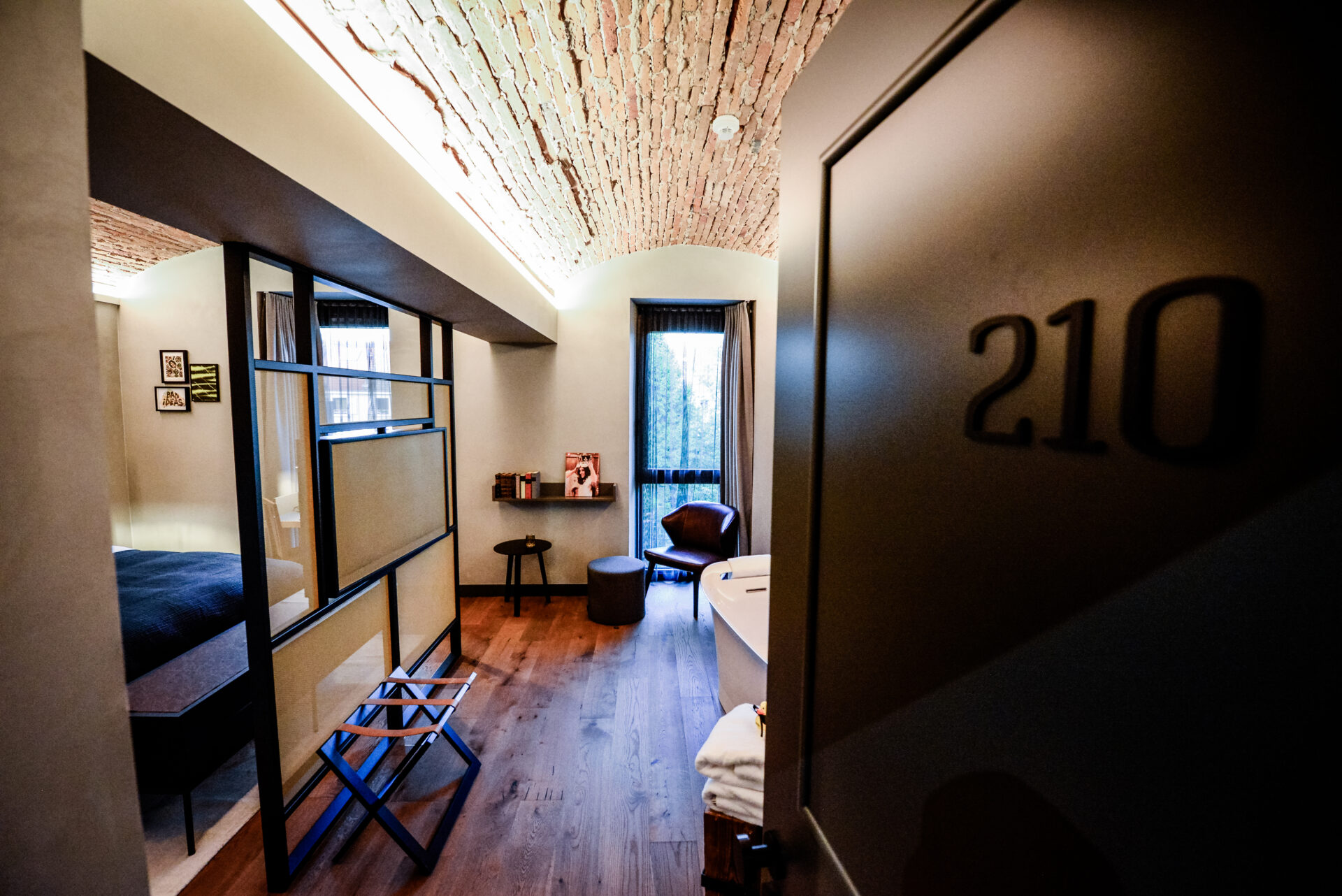
With a passion for detail, we breathed new life into these massive walls, blending old and new in a wonderful way. From now on, this colossal building with its massive windows and doors will always be open to you.
Phone:
Email:
Directions: Open route planner
Hotel information: open page
Newsletter: Open registration page
This awaits you at Liberty in Offenburg
- 0exceptional hotel rooms and suites.
- 0Employees for your well-being.
- 0Parking directly in front of the hotel.
- 0Philosophy:
Freedom – redefined.
The history of the Hotel Liberty
 19. century
Planning and construction of the prison
The construction of the prison at the Grabenallee is due to a judicial reform initiated by Grand Duke Leopold of Baden (1790-1852). Previously, prisoners were housed under catastrophic conditions, mostly in the city towers, in overcrowded, much too small rooms.ellewhere they vegetated idly. The Grand Duke commissioned his court architect, Heinrich Hübsch (1795-1863), to design prisons based on the American model to provide humane accommodation for the inmates. They modeled their design on the Eastern State Penitentiary in Philadelphia. This led to the creation of the Central District and District Prisons in Baden.
The location of the OffenburgThe construction of the official prison, also called “Villa Hübsch”, in the immediate vicinity of the Grimmelshausen Gymnasium (then Grand Ducal Gymnasium) was controversial from the beginning.
 20. century
The first modernization
In 1929, the prison was modernized, provided with electricity and built central heating, showers, sinks with running water, a library for the edification and education of the prisoners and a toilet in every room.elle Previously, the Zellen were heated by barred stoves, which were fired from the corridor by the "Schänzer" (inmates who were employed in housekeeping). Instead of water closets, chamber pots were used, which Adolf Geck remembers well during his tour of the modernized institution: "Once the prisoners woreelleowners when they check the Z in the morningellen cleaned the tin pots to the disposal site under the supervision of a guard."
Things were rather harmless in the OffenburgOnly three executions were carried out there over the years, the last in 1932. For this purpose, the dismantled guillotine was transported by train from Bruchsal to Offenburg transported and set up in the prison yard.

New construction and closure
Once again, a long and heated discussion erupted over the location of the new prison. Finally, it was agreed to build it in the west Offenburgs, in the intercommunal industrial park. In April 2009, the new prison with 440 places for criminal and pre-trial detention was opened and the venerable, historic prison at the Grabenallee closed its doors. The conversion of the old prison began with the idea of turning it into a hotel.
After two years of planning, the original architect's plans were scrapped. He had envisioned a central building with rooms between the two historic buildings. The hallways would have been significantly reduced to create more rentable square footage. This would have largely lost the historic character.


Before, afterwards